When it comes to improving as an improviser, there are only so many tunes you can memorize. Only so many chord symbols and progressions you can force into your brain… After a certain point you actually need to learn how to play over these sounds.
…and truth be told, this is something that took me a long time to understand.
For years I thought that memorizing more chords, more progressions, and more tunes would change the way I improvised. I actually believed that something magical was going to happen to my playing when I memorized 100 tunes!
Unfortunately all of this time and effort didn’t transform me into the next John Coltrane.
You see, improvement isn’t about piling on more information – it’s about mastering the information that you already have. And if your goal is to play better solos, you need to start focusing on specific chord progressions and mastering them one by one.
Lucky for us, the jazz repertoire isn’t comprised of random sequences of chords that change with every tune. If you look at the big picture, there are a handful of important jazz chord progressions that pop up over and over again…
And today we’re going to focus on one of them: the movement from I to IV.
We’ll dig into the theory behind this relationship, show you some important tunes that use it, check out some lines from great improvisers, and give you a blueprint for developing your own techniques to master this progression.
Let’s get started…
The I to IV relationship
Harmonic movement by a perfect fourth – moving from I to IV or modulating to the key of the IV chord – is a fundamental part of music.
You’ll find this relationship in pop tunes, nursery rhymes, Broadway musicals, symphonic works, and countless jazz standards. And it goes back to the symmetrical relationships found in the circle of 4ths:
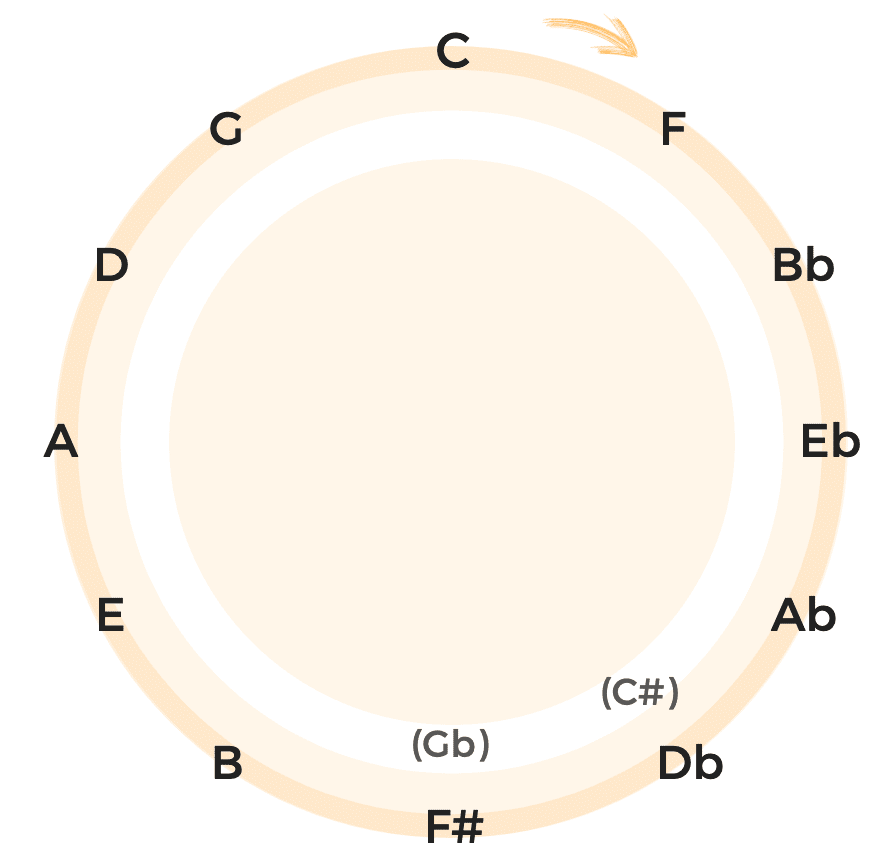
This root movement by perfect fourth has an inherent sense of forward motion and a feeling of arrival or resolution. This is because it’s the same as V7 to I movement (but more on this later).
Your first step in mastering this relationship should be to aurally and mentally ingrain this intervalic relationship around the circle.
A useful exercise is to visualize the root movement around the cycle in every key. Once you can do that, visualize a chord or arpeggio above this bass note.
Finally, practice linear exercises that outline this movement like the example below, resolving to the 3rd of each new key:

The end goal is to ingrain this movement in a harmonic as well as a linear fashion.
Direct movement vs. Temporary modulation
When we talk about the relationship between the I and IV chord, we don’t just mean moving diatonically from the I chord to the IV chord in a single key.
As an improviser, you’ll also encounter this relationship in tunes that begin in the tonic and over the course of the progression, modulate to the tonality of the IV chord.
Think of it this way…
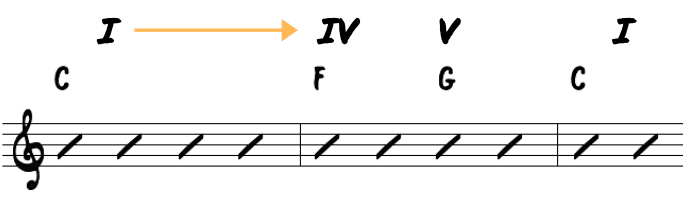
The first example is what we’ll call Direct movement – moving directly from the I chord to the IV chord. Essentially a diatonic progression in one key, like the one below:
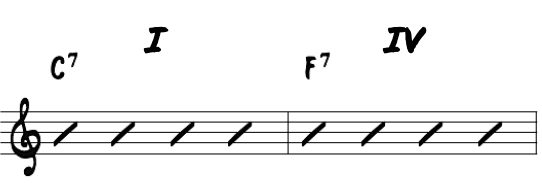
Or in the Blues where the I chord moves directly to the IV chord:
The second way you’ll encounter this movement is through what you might call a Temporary modulation – momentarily arriving at a new harmonic center.
The progression below begins in C (I chord) and quickly modulates to or arrives at the F (IV) chord:
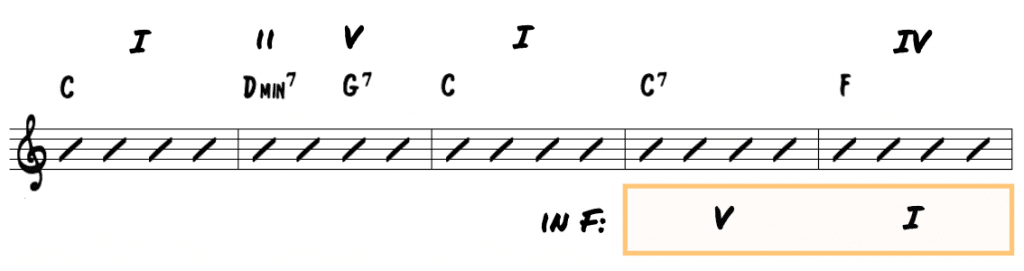
This progression or “tune” is in the key of C, but temporarily modulates to F (the IV chord) by way of a V7 chord or ii-V-I. You’ll find this type of progression in many jazz standards.
Understanding the larger picture of the theory behind this chord movement and relationship, rather than just memorizing individual chords, will allow you to unlock numerous harmonic and melodic possibilities.
Where do you find this chord relationship?
The I / IV relationship is a vital part of the jazz standard repertoire, one of the fundamental building blocks that occur in countless tunes.
The more you study this relationship, the more you’ll hear it popping up in the standards you practice everyday. And with a little know-how and practice, you’ll be able to quickly spot this progression in any tune that you play.
Below we’ll look at four tunes in the jazz repertoire that feature this movement from I to IV…
The Blues
The most common example of I to IV movement is the blues. Take a listen to Red Garland play this progression in C Jam Blues:
One of the defining features here is the movement from a dominant I chord to a dominant IV.
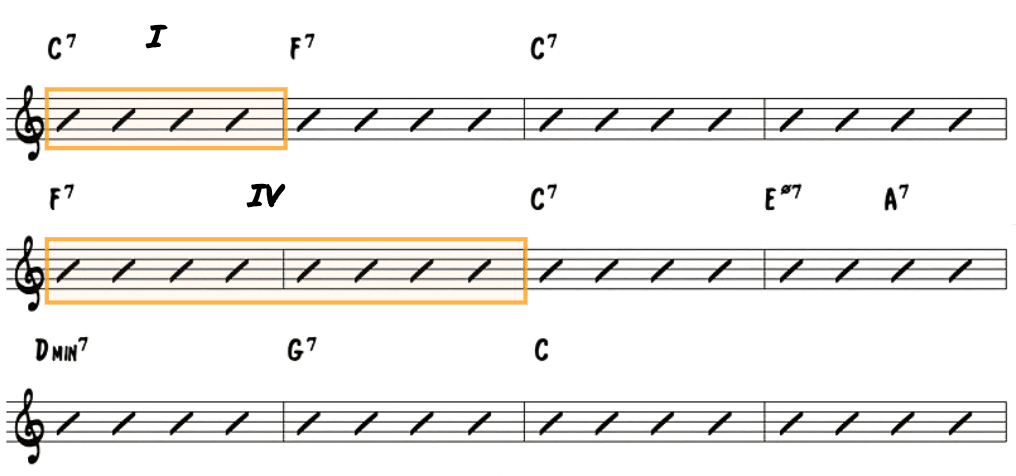
As you study these harmonic relationships, step one is knowing where the I and IV chords happen and step two is knowing how to connect them.
This direct movement from I to IV happens twice in the progression – between the first and second measures and again in the fifth and sixth measures:
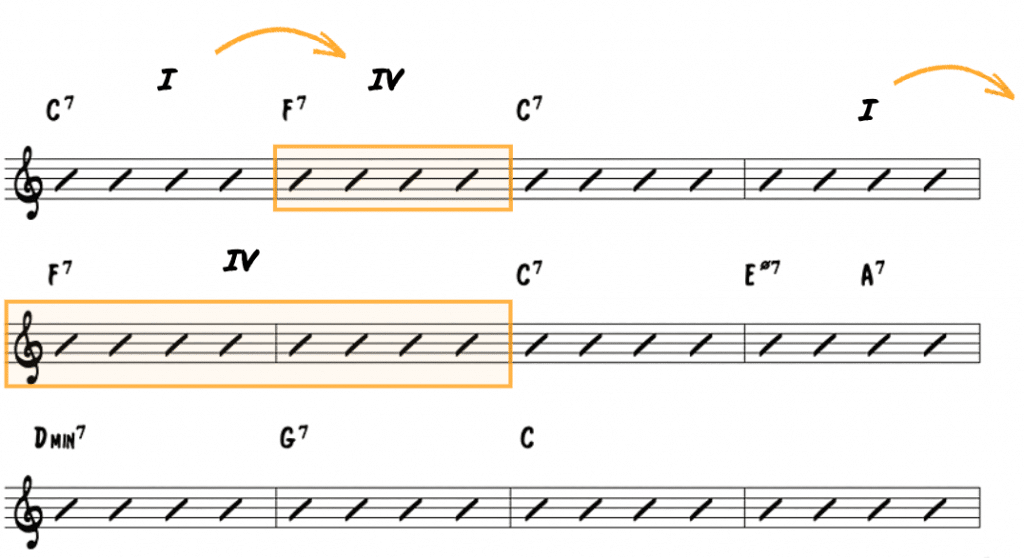
Cherokee
The next important jazz standard that features the I / IV relationship is Cherokee.
Listen to Art Tatum play through the tune and see if you can hear where this harmonic movement occurs:
*For an in-depth look at Cherokee, including transcriptions and solo techniques, PRO Members can access this lesson.
The progression begins on the I chord and resolves or arrives at the IV chord in the fifth bar:
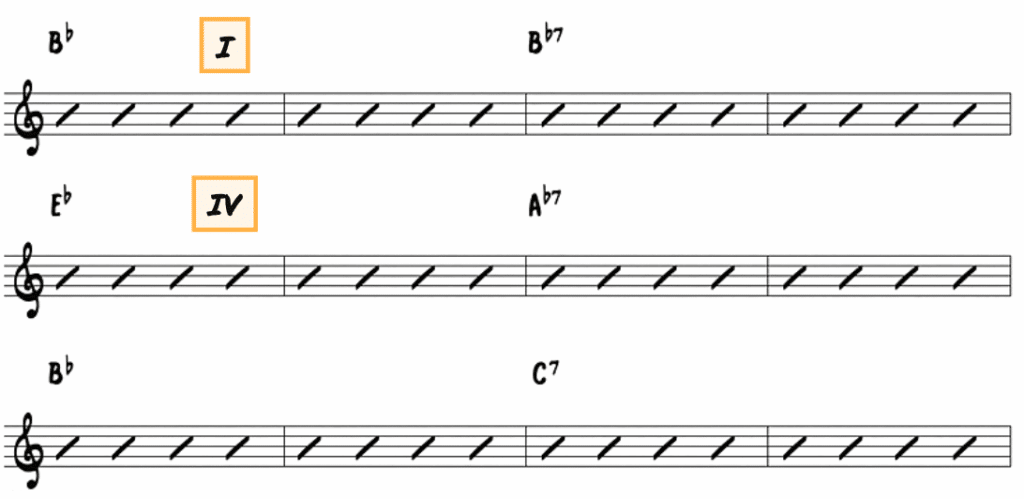
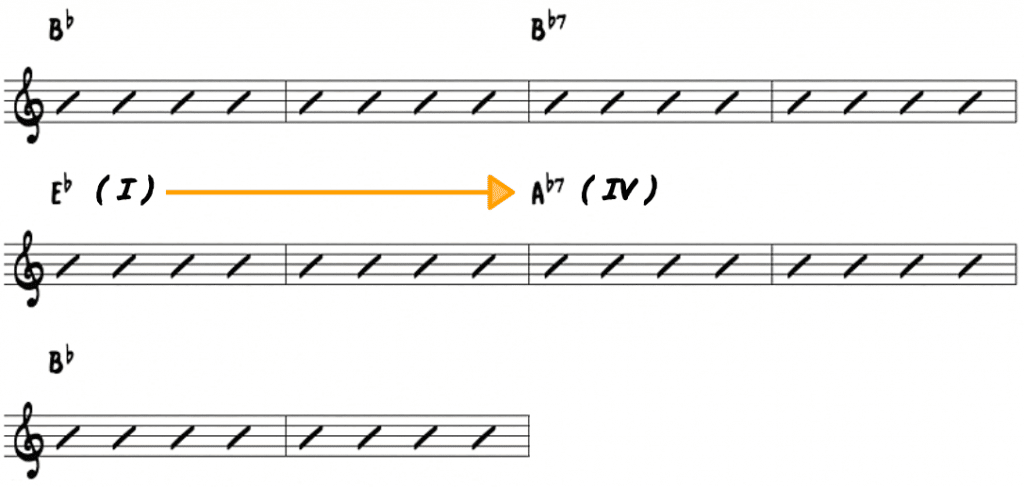
However, this movement by fourth happens one more time in the 5th and 6th bars, moving from the IV chord to the bVII (Eb to Ab7 below):
Rhythm Changes
Another tune where you’ll find this chord relationship is in the changes to I Got Rhythm…
*For a look at 6 Essential Rhythm Changes solos, PRO Members can access this lesson.
The I-VI-ii-V progression in the first four bars can be seen as diatonic movement in the I chord and the next “arrival point” is the IV chord in the sixth bar:
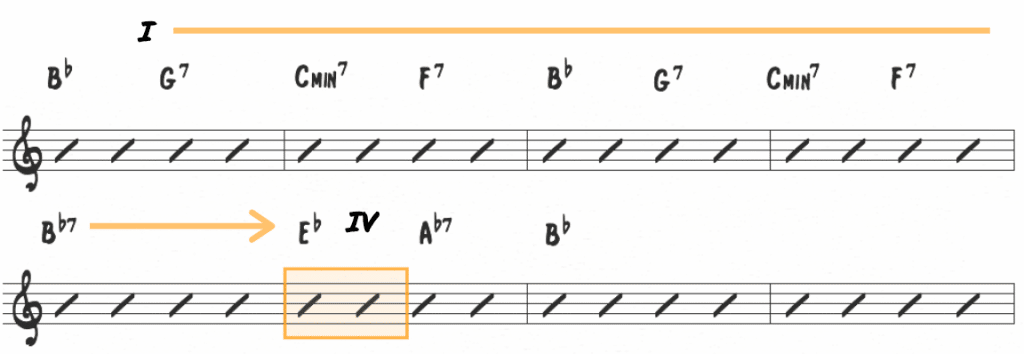
This movement is subtle and goes by quickly, but is important to know if you want to master rhythm changes. Also note how the IV moves to the bVII (another I to IV relationship), the same as in Cherokee, just in a truncated form.
This I to IV relationship can also be found on the bridge of Rhythm Changes:
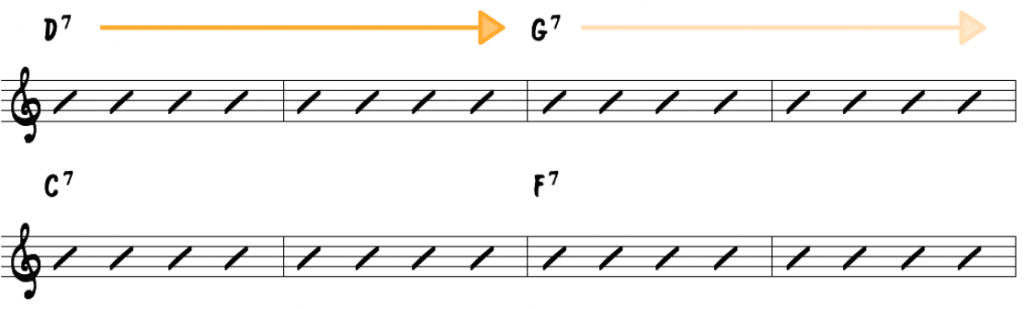
The bridge begins on the dominant III chord and moves around the cycle, arriving at the V7 chord. Here you find the I to IV movement not in diatonic function, but in the relationship between the chords.
Sweet Georgia Brown/ Dig
The last tune we’ll look at that utilizes this I to IV relationship or movement by fourths is Sweet Georgia Brown.
Check out Miles’ tune Dig, a contrafact or melody written over the progression of Sweet Georgia Brown:
Like the bridge of Rhythm Changes, the progression here utilizes the systematic movement around the circle of fourths with dominant chords, starting on the VI chord and eventually resolving to the I:
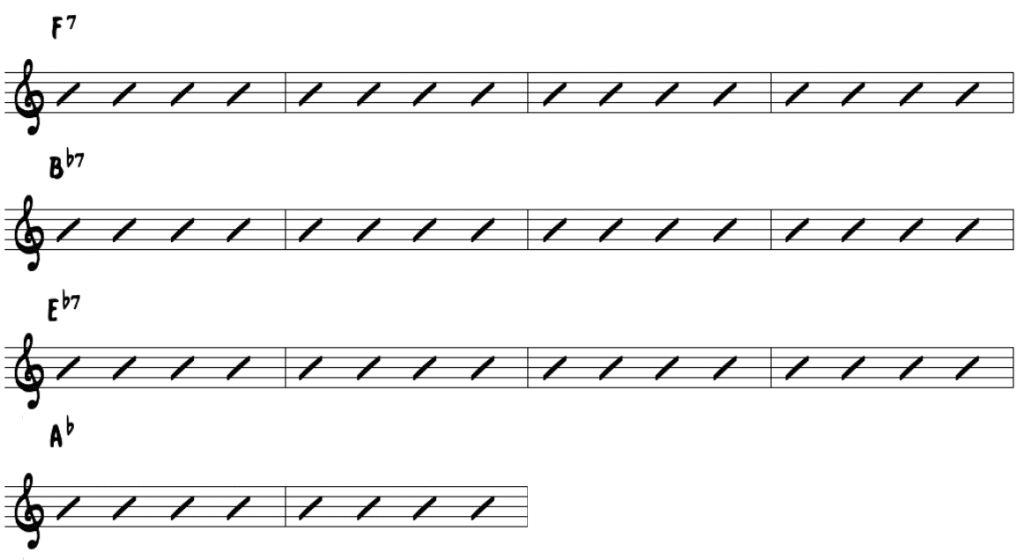
These four standards are just a few examples of the importance of the I to IV movement. Take a peek at the tunes you already know or want to learn and I’m sure you’ll find more.
Learning to Navigate this Chord Relationship
Here’s the thing to remember…simply knowing that certain tunes have a I chord or a IV chord in certain spots or memorizing dozens of chord progressions is not enough.
It’s one thing to be able to list off the chords to Rhythm Changes or Cherokee in all keys, but it’s another skill entirely to create a solo over these sounds.
To be able to improvise musical phrases you need to develop techniques for navigating these specific chord progressions. The goal is to be able to make melodic statements, moving seamlessly from one sound to the next.
And as you can see from the number of places where you’ll encounter this progression, developing some devices to play over these spots will prove to be especially useful.
Below we’ll show you some specific techniques that you can use over the I to IV movement that you find in the Blues, Cherokee, Rhythm Changes and many other places.
It’s important to remember that the way you approach this progression and the techniques you use depends on context – the tune, the larger progression, and the quality of the I and IV chords.
Here are four techniques for navigating the I to IV progression…
Hey, Sorry to Interrupt...
I know you were just getting into this lesson, but this one’s reserved for Jazzadvice PRO members.
Already a PRO member? Log in below to keep reading.